




New CNC milling machine or automation: which is the better investment?
New milling machine or automation: why this decision matters
Investing in a new milling machine is the classic and often obvious solution. It creates additional capacity and, in many cases, also expands technological capabilities.
At the same time, however, many manufacturers are dealing with challenges such as:
- rising labor costs
- limited availability of skilled workers
- high non-productive time caused by manual setup processes
- unused machine hours outside regular operating hours
This is exactly where automation becomes an alternative approach: optimizing existing CNC machines to make better use of available machine capacity.
Option 1: Buy a new milling machine: Advantages and limitations
Investing in an additional machine offers clear advantages. More spindles generally mean more output. At the same time, new machines often bring technological improvements — such as higher dynamics, greater accuracy, or additional machining capabilities. Redundancy is another important factor. An additional machine can increase production reliability in the event of downtime or machine failure.
These arguments are especially valid when:
- new machining processes are required
- existing machines are reaching their technological limits
- machine utilization is already consistently high
At the same time, adding another machine does not fundamentally change the existing production structure. Setup processes remain just as time-consuming, non-productive time still exists, and labor requirements typically increase along with the number of machines. In other words, the production structure itself remains unchanged — it is simply expanded.
Option 2: Automate the milling machine: How to significantly increase utilization
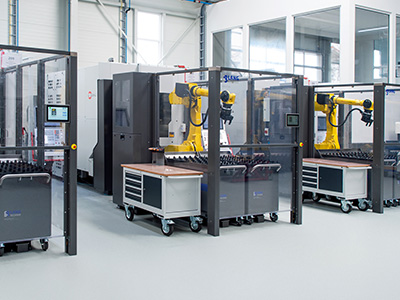
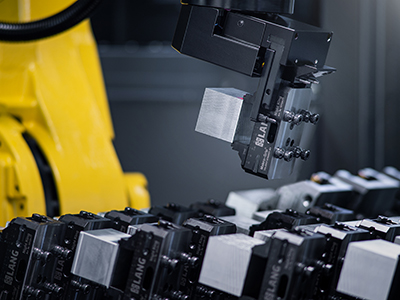
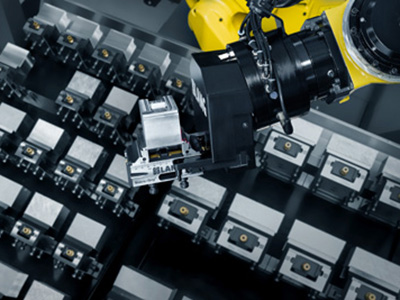
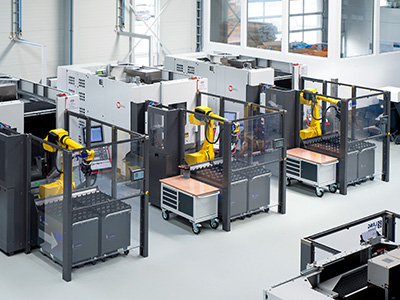
The alternative approach is to optimize the existing machine in a way that keeps it in the cutting process longer and more consistently. The key principle is separating setup operations from actual machining time.
The result is a more continuous manufacturing process with significantly reduced downtime. Another advantage is that many automation concepts today can be implemented largely independent of the specific machine type. In most cases, the machine brand itself is less important than how the manufacturing process is structured.
In addition, automation makes it possible to utilize machine hours that would otherwise remain unused — for example during evenings, overnight shifts, or weekends. In our article on automation of older milling machines, we show that such concepts can also be implemented for existing machines. We have also summarized what is important when planning in the article on automation of milling machines.
The crucial difference: capacity vs. utilization
To compare both approaches in a meaningful way, it helps to look at typical production figures from real-world manufacturing environments.
Assumptions (realistic for many manufacturers)
- Hourly rate for 5-axis machining: approx. 100 € / h
- Typical machine runtime without automation: 8–10 hours per day
- Typical machine runtime with automation: realistically 16–20 hours per day
- Production days per year: approx. 250–300 days
Scenario comparison from real-world manufacturing
The following examples illustrate, in simplified form, how different production scenarios can impact machine runtime, machine utilization, and overall economic performance.
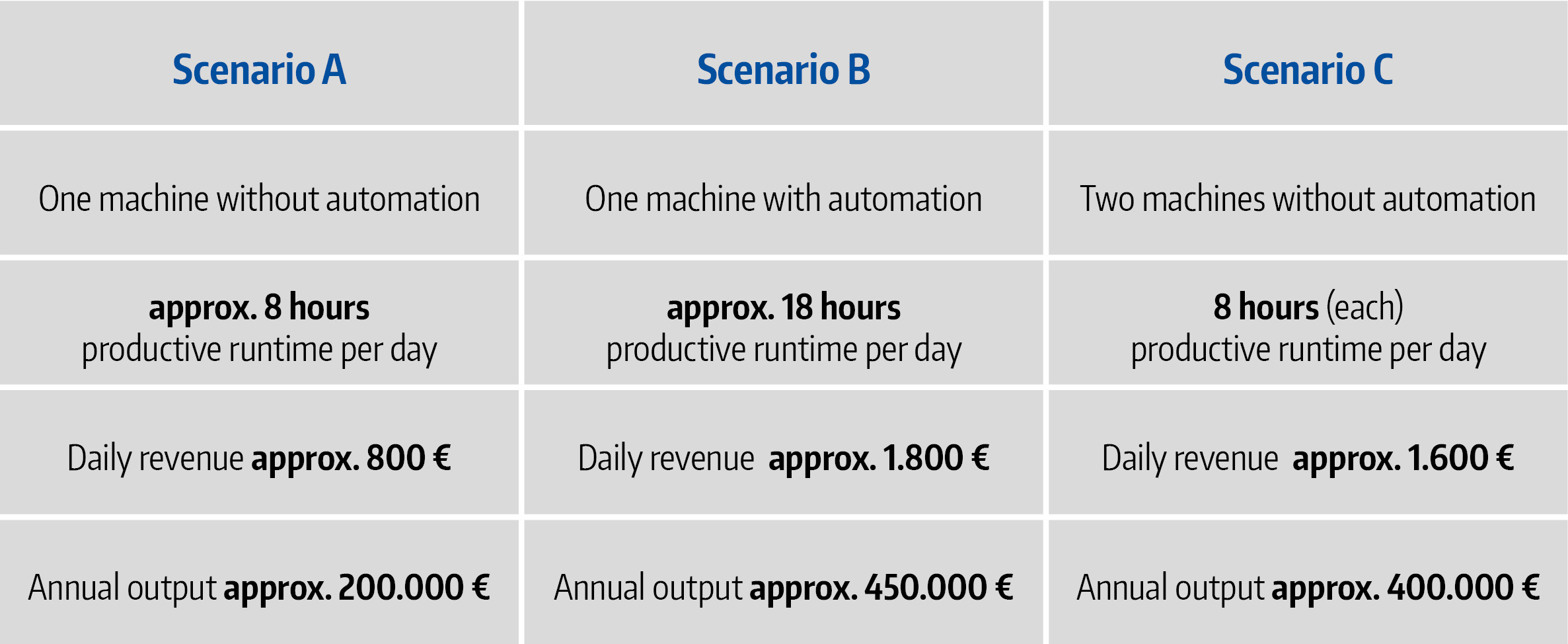
A single machine without automation typically achieves around 8 hours of productive runtime per day. With automation, that runtime can be increased significantly — for example to around 18 hours per day. This is made possible through reduced non-productive time, unattended machining, and additional operating hours. While adding another machine increases overall capacity, it also comes with higher requirements. Investment costs, labor requirements, floor space, and organizational complexity all increase accordingly. The comparison highlights a key difference: while a second machine primarily adds capacity, automation improves the utilization of existing machine capacity.
When a new machine is the right decision
A new machine is especially useful — or even necessary — when new materials or machining strategies require different technologies, existing machines reach their physical limits, or additional capacity is needed on a long-term basis.
Typical limitations include:
- work envelope
- spindle power
- accuracy
In these situations, an additional machine can be a valuable expansion of production capabilities.
When automation offers the greater advantage
Automation delivers the greatest benefits when existing machine capacity is not yet being fully utilized. This is often the case when:
- machines sit idle for large parts of the day
- setup times consume a significant share of overall production time
- labor cannot easily be scaled
- existing machines are not yet fully utilized
This is where many manufacturers underestimate the real impact: the same machine can generate significantly more output — without fundamentally changing the production structure.
In short:
Whether investing in a new milling machine or automation makes more sense ultimately depends on where the actual bottleneck is located:
- If the limitation is overall production capacity, investing in a new machine is often the right choice.
- If the limitation is machine utilization, automation is frequently the more economical solution.
Conclusion: The better investment depends on the real bottleneck
Whether it makes more sense to invest in a new milling machine or automate an existing CNC machine cannot be answered universally. The key question is where the actual bottleneck lies — in overall capacity or in machine utilization.
If technological capabilities are missing or available capacity has already been fully exhausted, investing in an additional machine is often unavoidable. However, when non-productive time, lengthy setup processes, and machine downtime dominate daily production, the greater potential often lies in automation.
Ultimately, the efficiency of a manufacturing operation is not defined by the number of machines on the shop floor, but by how effectively those machines are utilized. This is exactly where modern workholding and automation concepts such as RoboTrex come into play: helping manufacturers use existing machine capacity more productively and economically.
Interesting links
Questions and answers
When is CNC automation the right choice?
Automation often offers the greatest economic leverage when machines are underutilized and non-productive times dominate,
What’s the typical machine runtime with automation?
In real-world manufacturing environments, machine runtimes of 16–20 hours per day are entirely realistic — depending on the application and overall process stability.
Is automation possible on existing machines?
Yes. Many automation systems can be retrofitted — even on older milling machines.
Which Is more cost-effective: a second machine or automation?
In many cases, automation is the more economical solution because it makes better use of existing machine capacity.
What is the biggest difference between a new machine and automation?
A new machine increases overall capacity, while automation improves the utilization of existing machines. In many cases, the greater economic advantage lies in making better use of existing resources.


